Nestled within the Seychelles' splendour lies Félicité. A 268-hectare island comprised of jet-black Jurassic granite forms embroidered with lush vegetation, vanilla orchids, coconut palms and wild mango, Félicité is a secluded haven that places homeowners at the very heart of the Seychelles experience. It is a singular island endowed with extraordinary features and a sense of discovery fulfilled by powder-soft white beaches, sparkling bays, unique granite rock formations, hidden caves and crevices.
This picturesque and steep granitic island was a coconut
plantation up to the 1970s and supported a population of some 50 people. In the
late 19th century, Félicité was home to the Sultan of Perak, one of Seychelles’
most colourful exiles, who spent five years on the island before moving to
Mahé.
Until recently, the island was home to an up-market lodge
offering an exclusive island experience to the likes of British Prime Minister
Tony Blair. Now, Per Aquum, the internationally renowned resort and
spa company is launching a project on the island which will feature 35
ocean-facing villas, the world’s only rock wine cave, spa and wide choice of
restaurants, bars and boutiques. 28 cutting-edge, hilltop residences will also
be for sale on the island through Per Aquum Residences.
The island is ideal for divers, snorkelling enthusiasts, and hikers due to it's beautiful waters and mountainous terrain. Day excursions to the island can also be arranged.
Images from the island...
Cousine is situated approximately 6km off the west coast of Praslin and offers
an exclusive island experience with complete privacy found in very few other
places on earth. The island is 25 hectares (62 acres) in size; approximately 1.4km in length, 800m in width and is 100% dedicated to the preservation of the Seychelles environment.
Cousine is a private nature reserve, home to five of the
Seychelles endemic birds such as the Seychelles magpie robin and Seychelles
brush warbler, as well as a variety of endemic fauna and spectacular marine
life. There are some large specimens of the giant land tortoise wandering
the island, which is also a nesting site for the hawksbill
turtle.
The vegetation consists of 95% endemic plants and is home to
more than 7 land birds (Seychelles Magpie Robin, Seychelles White-eye,
Seychelles Brush Warbler, Seychelles Fody/Tok Tok, Madagascan Fody, Seychelles
Turtle Dove and the Seychelles Blue Pigeon) and 9 breeding seabirds
(Wedge-tailed Shearwater, Audobon Shearwater, Brown Noddy, Lessor Noddy, Sooty
Tern, Fairy Tern, Bridal Tern, White-tailed Tropic Bird, Red-tailed tropic bird)
as well as a variety of migratory birds – the remaining 5% of vegetation is made
up of indigenous fruit trees and vegetable plants which is used as a food source
for the staff and guests. Fruit bats feed on the Ficus trees and the island's
undergrowth is home to a variety of insects, lizards and
gecko's.
Migratory birds consider Cousine home during 6 months of the
year. Hawksbill Turtles come ashore to nest and Green Turtles, rare to the
Seychelles, nest occasionally throughout the year. Cousine Island is one of the
few islands in the Seychelles to be completely free of alien mammals.
It is now home to a superb resort that offers an exceptional experience within a private nature reserve.
With four individual Old French Colonial style villas, exclusivity is the order of the day as a maximum of only ten guests are accommodated at any one time. In fact, this is one of the few islands that can be rented in it's entirety, you don't get more private than that!
Photos from Cousine...
Curieuse lies just off the north-western coast of its close neighbour Praslin
and is now a reserve managed by the Seychelles Centre for Marine Technology -
Marine Parks Authority.
It all started a bit nasty
for settlements on Curieuse. Here, it is much drier than on Praslin - and
especially Mahé - as it rains a little bit less and more importantly because the
soil cover is too small to store much ground water. Poor soils in general made
agriculture a bad idea on Curieuse.
Once known as Ile Rouge on account of its red
earth, Curieuse was eventually named after one of explorer Marion Dufresne's
vessels which explored the islands of the Praslin group in 1768.
This
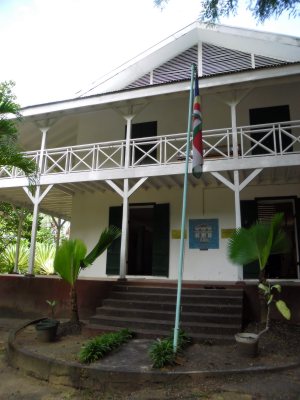
rugged island was once home to a leper colony situated at Anse St. Joseph, and
whose resident doctor's house dating back to the 1870's has recently been
converted into an eco-museum and visitors centre.
Aside from Praslin,
Curieuse is the only other island where the Coco-der-mer grows naturally, and
also boasts an endemic vine and eight different species of
mangrove.
Today Curieuse is home to an exciting giant land tortoise
rearing project. The island is also an important nesting site for hawksbill
turtles.
No accommodation is offered on this island, but excursions can
be arranged through local ground handling operators, and Seychelles Yacht Charter regularly visits Curieuse on charters where it affords guests the opportunity to visit the tortoise sanctuary, and take the mile long hike across across the island, through the nature reserve, and on to the former leper colony where one can visit the doctor's house and museum. It truly is a great day out!
Photos from Curieuse...
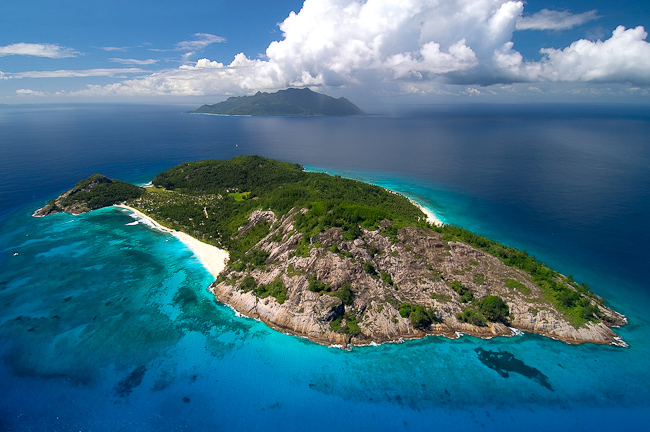
North lies only a few kilometres north of Silhouette and is the smaller of two
visible in the distance from the beach at Beau Vallon on Mahé.
North was
one of the very first Seychelles islands to be visited in a 1609 expedition
under Captain Alexander Sharpeigh who found the island to have excellent ‘cokker
nutts’ (i.e. coconuts) as well as a thriving population of giant land
tortoises. From 1826 until the 1970s, North Island was owned by the Beaufond family from Reunion. During this time the island was a plantation for growing fruit and spices, as well as producing guano, fish oil and copra. After the plantation was sold in the 1970s, the island fell into disuse, and was taken over by feral animals and alien species of weeds
Widely regarded as one of Seychelles' most fertile islands,
until recently North had been inhabited by smallholders producing vegetables,
tending and harvesting the coconut plantations for shipment to Mahé, and
engaging in fishing.
In 2003 Wilderness Safaris (a South African comoany) opened an 11-chalet,
five-star resort on the island targeting the luxury eco-tourism market,
promising visitors interaction with the island’s biodiversity at the same time
offering a high standard of barefoot luxury.
The management is remaking
the island into a wildlife sanctuary it dubs the “Noah’s Ark” project, a
long-term plan to rehabilitate the island’s habitats to what it was before the
introduction of human settlement, and to introduce endangered flora and fauna on
the island to help preserve some of Seychelles’ precious endemic
species. It is one of the most ambitious conservation projects ever undertaken by a private company.
Photos from North Island...
Many thanks to www.seychelles.travel.sc
Situated approximately 55km from Mahé, Frégate and is the most distant of the
granitic Inner Island group. It was a popular pirate haunt during
the latter part of the 17th century and stories persist of treasure hidden
somewhere on its 280 hectares, although I am yet to confirm those stories!
A three-kilometre square fragment splintered from the prehistoric ark-continent of Gondwana, which once united South America, Africa, India and the Antarctic: like much of the Seychelles, Frégate Island remained beyond the reach of the major evolutionary developments, and man, for hundreds of millions of years. This allowed secluded pockets of untouched nature to flourish.
The Seychellois magnate Harry Savy
purchased the island after World War II, transforming it into a highly
profitable venture by growing vegetables, fruit, coffee, vanilla, cinammon and
poultry for markets on Mahé. The island sustained a population of some 100
persons, busily engaged in Savy’s several lucrative enterprises.
The island is home to no less than fifty
species of birds, among which is the rare Seychelles magpie robin, and also
hosts the world’s only population of the giant tenebrionid beetle as well as
numerous giant tortoises.
Frégate features a luxurious five-star
eco-lodge offering the optimum in comfort and amenities that has become a
favourite hideaway for Hollywood stars, with deluxe villas right on the
foreshore to ensure each has a million-dollar sea view. Meanwhile guests are
encouraged to engage themselves in the island’s many conservation projects, run
by ecologists charged with keeping the island naturally pristine.
Photos...
Denis lies 95km north of Victoria, Mahé and 45km from Bird Island, making it one
of the most northerly of all the Seychelles' islands.
Like many
Seychelles islands, in the heyday of the coconut industry Denis was a coconut
plantation, whose population of between 70 and 100 persons were engaged in
collecting guano (decomposed bird droppings), producing coprah (refined coconut
flesh) and fishing.
In 1975 the island was purchased by Pierre Burkhardt,
a French paper magnate who ran the island as a successful lodge with the
marketing slogan “the island at the edge of the world.” The island was sold to
Mason's Travel, one of Seychelles’ first local ground handling operators, in the
mid ‘90s.
Denis' 350 acres is home to a varied vegetation and populations
of sea and land birds including frigates, white-tailed tropic birds, whimbrels,
doves, wood pigeons, cardinals and mynahs. The island is the recent beneficiary
of a successful project to introduce endangered species of birdlife.
For
fishermen it is ideally situated for deep-sea fishing expeditions on the nearby
edge of the Seychelles’ bank where marlin, sailfish, barracuda, wahoo, dorado
and tuna will thrill novice and seasoned fisherman alike.
Denis offers
excellent nature walks as well as the facilities of tennis, diving, windsurfing,
canoeing and of course sunbathing on its gleaming white beaches and its 5-star
25-chalet lodge is the perfect honeymoon getaway offering seclusion in comfort
and with excellent gourmet cuisine.
Photos from Denis...
Situated within the Ste Anne Marine National Park, Cerf is Mahé’s closest
neighbour and offers excellent swimming and snorkelling as well as memorable
sunbathing on several great beaches.
Cerf is a popular picnic venue with
Mahé residents on account of its fine beaches and good swimming.
Cerf
earned its name from the navy frigate that visited Seychelles in 1756 to take
formal possession of the island in the name of France.
The island once
had a thriving coconut industry, the remnants of which are still evident in the
form of lush coconut groves. Many exotic shrubs adorn its 116 hectares that is
also home to a population of giant land tortoises and flying foxes.
Cerf
is the only island in the marine park to have a small local population who
commute to Mahé for their daily business, making the 4km trip in a matter of
minutes.
A high standard of accommodation is available in three hotel
establishments currently on the island as is the opportunity to savour
mouth-watering Seychellois Creole cuisine.
Photos from Cerf Island...